Support our educational content for free when you purchase through links on our site. Learn more
🎧 Ultra High-End Audio: The Ultimate Guide to Sonic Perfection (2026)

The truth is, ultra high-end audio isn’t about buying the most expensive gear; it’s about eliminating every barrier between you and the raw emotion of the recording. While a $50 system plays the notes, a $50,0 system reveals the breath of the singer, the texture of the strings, and the acoustic space of the studio.
We once sat in a listening room where the silence between tracks felt so profound it was almost physical. The difference wasn’t just volume; it was the micro-dynamics that made the music feel alive. In this guide, we dissect the technology, the psychology, and the components that define the pinnacle of sound reproduction.
Key Takeaways
- Room Acoustics Trump Gear: Even the most expensive speakers will fail without proper acoustic treatment and vibration control.
- GaN Technology is the Future: Gallium Nitride amplifiers now offer the speed of solid-state with the warmth of tubes in compact chassis.
- Source Quality is Non-Negotiable: A high-end Music Server or DAC is essential to unlock the full potential of your system.
- Diminishing Returns Apply: The jump from $5k to $50k is massive, but the jump from $50k to $50k is subtle and highly subjective.
👉 Shop Ultra High-End Gear:
- Amplifiers: Orchard Audio Starkrimson | Taiko Audio Servers
- Speakers: Marten Audio | Wilson Audio
- Headphones: Sennheiser HE 1 | Stax Electrostatic
Table of Contents
- ⚡️ Quick Tips and Facts
- 📜 The Genesis of Ultra High-End Audio: From Hi-Fi to Audiophile Nirvana
- 🔍 Defining the Elite: What Actually Separates Ultra High-End from Premium Gear?
- 🏗️ The Holy Trinity of Components
- 1. 🎛️ Source Matters: The Quest for the Perfect Digital and Analog Front End
- 2. 🔊 Amplification Architecture: Tube, Solid-State, and the Hybrid Revolution
- 3. 🎵 Transducer Mastery: Why Ultra High-End Speakers and Headphones Cost More Than a Car
- 🔌 The Invisible Chain: Cables, Power Conditioning, and Isolation
- 1. 🧵 Interconnects and Speaker Cables: Do They Really Make a Difference?
- 2. ⚡ Power Regeneration and Conditioning: Feding Your Gear the Cleanest Juice
- 3. 🛑 Vibration Control: Racks, Stands, and Decoupling for Pure Sound
- 🏠 Room Acoustics: The Most Critical Component You Can’t Buy Off the Shelf
- 🧠 The Psychology of Listening: Why Your Brain Hears What You Expect
- 💰 The Value Proposition: Is the Ultra High-End Audio Premium Worth the Investment?
- 🛠️ Setting Up Your System: A Step-by-Step Guide to Optimization
- 🎧 Headphone vs. Speaker: The Ultimate Showdown in the Ultra High-End Realm
- 🚀 Future Trends: Where is the Ultra High-End Audio Industry Heading?
- 🏆 Conclusion
- 🔗 Recommended Links
- ❓ FAQ
- 📚 Reference Links
⚡️ Quick Tips and Facts
Before we dive into the deep end of the sonic ocean, let’s get our bearings. If you’re new to the concept of ultra high-end audio, you might be wondering if it’s all just expensive marketing fluff or if there’s actual science behind the sky-high price tags. Here’s the scoop from our team at Audio Brands™:
- Diminishing Returns are Real: Moving from a $50 system to a $5,0 system yields a massive jump in quality. Moving from $50,0 to $50,0? The improvement is subtle, often measured in micro-dynamics and timbral accuracy rather than sheer volume or bass thump.
- The Room is King: You can drop a million dollars on speakers, but if your room has untreated reflections, you’re just listening to an expensive echo chamber. Room acoustics often matter more than the gear itself.
- GaN is the New Black: Forget old-school Class A tube amps for raw power. Gallium Nitride (GaN) technology is revolutionizing amplification, offering the speed of solid-state with the warmth of tubes, all in a chassis the size of a toaster.
- Cables Aren’t Magic, But They Matter: While a $10,0 cable won’t fix a bad recording, high-quality interconnects and power conditioning can remove “noise” from the signal path, revealing details you didn’t know were missing.
- Subjectivity Rules: What sounds “warm” to one person sounds “muddy” to another. Personal preference is the ultimate metric.
For a deeper dive into the brands that define this space, check out our 🏆 The Ultimate HiFi Brands List: 150+ Audio Giants Ranked (2026).
📜 The Genesis of Ultra High-End Audio: From Hi-Fi to Audiophile Nirvana
The journey to ultra high-end audio didn’t start with million-dollar speakers; it started with a simple desire: to hear the music exactly as the artist intended.
In the 1950s and 60s, “High Fidelity” (Hi-Fi) was a buzzword for equipment that could reproduce sound with minimal distortion. Brands like Marantz, McIntosh, and Thorens built the foundation. But as technology advanced, a split occurred. One path led to mass-market convenience (think Bluetooth speakers), and the other led to an obsessive pursuit of perfection.
By the 1980s, the term “Audiophile” entered the lexicon. This wasn’t just about listening; it was about listening. Enthusiasts began experimenting with tube amplifiers (which had been discarded by the mainstream for solid-state) because they added a “musicality” that early digital recordings lacked.
The 190s and 20s saw the rise of digital audio and the realization that the “source” was often the weak link. This birthed the era of the High-End Music Server and the Digital-to-Analog Converter (DAC) as a standalone component. Today, we are in the era of Ultra High-End, where the focus has shifted to micro-details, transient response, and spatial imaging. It’s no longer just about playing a song; it’s about reconstructing the acoustic space of the recording studio in your living room.
🔍 Defining the Elite: What Actually Separates Ultra High-End from Premium Gear?
So, where do we draw the line? Is a $5,0 amplifier “ultra high-end”? Not quite.
Premium Audio (think $2k–$10k range) is about excellent performance, great build quality, and reliable features. It’s the “luxury car” of audio.
Ultra High-End Audio (often $20k and up, easily reaching six figures) is about engineering without compromise. Here’s how we distinguish them:
| Feature | Premium Audio | Ultra High-End Audio |
|---|---|---|
| Component Selection | High-quality off-the-shelf parts | Custom-matched, hand-selected components (e.g., 1% tolerance capacitors) |
| Power Supply | Standard linear or switching | Multi-stage, isolated, massive capacitance, often custom-wound transformers |
| Chassis | Aluminum or steel, standard machining | Aircraft-grade aluminum, copper, Panzerholz, or exotic composites for vibration damping |
| Design Philosophy | Cost-to-performance ratio | “Cost is no object” – performance is the only metric |
| Listening Goal | Enjoyable, accurate sound | Musical realism, “you are there” presence, zero coloration |
| Support | Standard warranty, email support | White-glove service, often including in-home setup and tuning |
As the team at Blink High End in New England notes, the goal is to supply the “highest quality audio systems” to deliver the “truest sound.” They emphasize that their selection is based on technology the engineers trust and use daily, not just what sells.
🏗️ The Holy Trinity of Components
In the world of ultra high-end audio, the system is only as strong as its weakest link. We call the three pillars of this ecosystem the Holy Trinity: Source, Amplification, and Transducers.
1. 🎛️ Source Matters: The Quest for the Perfect Digital and Analog Front End
If your source is muddy, your system will be muddy. Period.
In the analog realm, we’re talking about turntables that cost more than a house. Brands like Clearaudio and VPI offer systems where the tonearm is a marvel of physics, and the platter is a vibration-dampening masterpiece.
But the real revolution is in the digital domain. The days of the “computer as a source” are fading. Enter the High-End Music Server.
Take the Taiko Audio Extreme. It’s not just a computer; it’s a dedicated audio engine.
- Dual CPU Architecture: One CPU handles the user interface (Roon), while the other is dedicated solely to the audio stream. This isolation eliminates the “jitter” and noise that standard PCs introduce.
- PCIe Storage: By bypassing the motherboard’s DMI chipset and using direct PCIe modules, Taiko achieves speeds 4x faster than standard SSDs, resulting in “black backgrounds” and incredible space rendition.
- Passive Cooling: No fans means zero noise. The custom copper heat sinks are machined to 5-micron tolerances.
“The Taiko Extreme gets me closer to the music, closer to what the musicians are conveying to me, and closer to the room/venue that the recording was recorded in than I have previously experienced.” — Enjoy the Music
If you want to explore more about the best gear in this category, browse our Audio Brand Guides or dive into our Audio Software section for the best players.
👉 CHECK PRICE on:
- Taiko Audio Extreme: Amazon | Taiko Audio Official
2. 🔊 Amplification Architecture: Tube, Solid-State, and the Hybrid Revolution
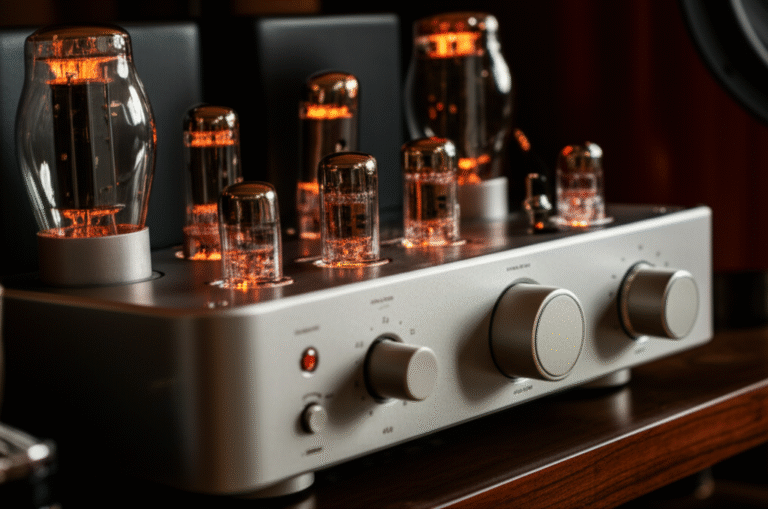
For decades, the debate was Tube vs. Solid-State. Tubes offer warmth and harmonic richness; solid-state offers speed and power. But ultra high-end engineers have found a third way: Gallium Nitride (GaN).
GaN transistors switch at frequencies up to 0.8 MHz, offering the transient speed of solid-state with the musicality of tubes.
Let’s look at the Orchard Audio Starkrimson Mono Ultra Premium.
- Power: 250W into 8 ohms, but capable of driving difficult loads like Magnepans with ease.
- Architecture: Fully balanced from input to output, utilizing a proprietary dual-feedback architecture.
- Size: Compact. No massive, heavy chassis. Just pure performance.
Reviewers are raving:
- Mark Marcantonio (Audio Pursuit): “My highest recommendation… terrific clarity, top notch, resolution.”
- John Hoffman (Positive Feedback): “Affordable yet possessing stellar vocal reproduction.”
👉 CHECK PRICE on:
- Orchard Audio Starkrimson Mono Ultra Premium: Amazon | Orchard Audio Official
3. 🎵 Transducer Mastery: Why Ultra High-End Speakers and Headphones Cost More Than a Car
This is where the rubber meets the road. The transducer (speaker or headphone) is the only component that converts electrical energy into sound waves. If it fails, the magic is gone.
In the ultra high-end speaker world, we are talking about Martens, Tidal, and Wilson Audio.
- Marten Coltrane Supreme Extreme: Priced around $1 million, these floorstanders use carbon fiber and massive arrays of drivers to create a soundstage so wide it feels like the room has vanished.
- Tidal La Assoluta: The “Bugatti of home audio.” Featuring pure diamond drivers, these speakers are engineered to eliminate resonance entirely.
- Kharma Enigma Veyron 1D: A “time machine” for sound, using active, modular design to adapt to any room.
As noted in a popular video showcasing these giants, the Wilson Audio WAM Master Chronosonic is described as a “mechanical sculpture.” The engineering required to make a speaker that weighs 1,80 pounds and has 30 bass drivers is staggering.
But what about headphones? The Sennheiser HE 1 (Orpheus) system costs as much as a luxury car. It features an electrostatic driver powered by a vacuum tube amplifier, all housed in a marble block.
👉 Shop Headphones on:
- Sennheiser HE 1: Amazon | Sennheiser Official
- Stax SR-09S: Amazon | Stax Official
🔌 The Invisible Chain: Cables, Power Conditioning, and Isolation
You’ve spent $10k on your system, but you’re using the cables that came with your TV? Stop.
1. 🧵 Interconnects and Speaker Cables: Do They Really Make a Difference?
Skeptics say cables are a scam. We say they are the invisible chain. In an ultra high-end system, the signal is so pure that any resistance, capacitance, or inductance in the cable can alter the sound.
- Interconnects: Brands like Nordost, AudioQuest, and Siltech use exotic materials like silver and gold-plated conductors to minimize signal loss.
- Speaker Cables: The gauge and material matter. Transparent Audio and Chord Company offer cables that maintain phase coherence and reduce jitter.
2. ⚡ Power Regeneration and Conditioning: Feding Your Gear the Cleanest Juice
Your wall outlet is dirty. It has noise from your fridge, your Wi-Fi router, and the neighbor’s microwave. Power conditioners like those from Shunyata Research or Isotek filter this noise.
- Regenerators: Devices like the PS Audio Power Plant take AC power, convert it to DC, and then regenerate a clean, sine-wave AC power. This can dramatically improve dynamic range and bass control.
3. 🛑 Vibration Control: Racks, Stands, and Decoupling for Pure Sound
Vibration is the enemy of sound. A turntable needle vibrating from a nearby subwoofer? Disaster.
- Racks: IsoAcoustics and Audiopipe offer racks that decouple components from the floor.
- Footers: Acoustic Revive and Stillpoints use materials like copper and glass to absorb mechanical vibrations.
👉 Shop Accessories on:
- Shunyata Research Power Conditioners: Amazon | Shunyata Official
- IsoAcoustics Stands: Amazon | IsoAcoustics Official
🏠 Room Acoustics: The Most Critical Component You Can’t Buy Off the Shelf
Here’s the hard truth: Your room is the most important component in your system.
Even the best speakers in the world will sound terrible in a room with parallel walls and no treatment. Sound waves bounce, creating standing waves (bomy bass) and comb filtering (hollow mids).
- Bass Traps: Essential for controlling low frequencies.
- Diffusers: Break up high-frequency reflections to create a natural soundstage.
- Absorbers: Tame mid-range reflections.
Many ultra high-end dealers, like Blink High End, offer in-home consultations to tune the room. They understand that acoustic treatment is not an afterthought; it’s the foundation.
🧠 The Psychology of Listening: Why Your Brain Hears What You Expect
Why do some people hear “warmth” in a tube amp while others hear “mud”? It’s psychology.
Our brains are wired to expect certain things. If you believe a $10,0 cable sounds better, your brain will likely convince you it does. This is the placebo effect in audio.
However, blind testing has shown that when listeners don’t know what they are hearing, they often prefer the sound of ultra high-end gear. Why? Because the micro-dynamics and transient response are objectively superior. The brain can detect the difference even if the conscious mind is skeptical.
💰 The Value Proposition: Is the Ultra High-End Audio Premium Worth the Investment?
Is it worth it? That depends on what you value.
- For the Casual Listener: Probably not. A $2,0 system will sound 90% as good as a $20,0 system for most people.
- For the Audiophile: Absolutely. The last 10% of performance is where the magic lies. It’s the difference between watching a movie on a 1080p TV and a 4K IMAX screen.
As the video on the most expensive speakers notes, “The sky is the limit, but if you look deep into space, there are no limits.” For those who seek musical realism, the investment is justified.
🛠️ Setting Up Your System: A Step-by-Step Guide to Optimization
Ready to build your dream system? Follow these steps:
- Define Your Budget: Be realistic. Don’t spend it all on speakers; leave room for room treatment.
- Choose Your Source: Start with a high-quality DAC or Music Server.
- Select Amplification: Match the amp to your speakers. GaN amps are great for difficult loads.
- Pick Your Transducers: Listen to as many as possible. Marten, Wilson, Tidal all have different sonic signatures.
- Treat Your Room: Install bass traps and diffusers before buying expensive cables.
- Optimize Placement: Use the 38% rule for speaker placement.
- Fine-Tune: Adjust cable orientation, power conditioning, and vibration control.
🎧 Headphone vs. Speaker: The Ultimate Showdown in the Ultra High-End Realm
Headphones offer a level of detail and isolation that speakers can’t match. The Sennheiser HE 1 or Stax SR-09S can reveal every breath of the singer.
Speakers, however, offer a natural soundstage. You don’t have the “in-your-head” effect of headphones. You hear the room, the reverb, the space.
Which is better? It depends on your listening environment. If you have a dedicated listening room, speakers are king. If you live in an apartment, ultra high-end headphones might be your only option.
🚀 Future Trends: Where is the Ultra High-End Audio Industry Heading?
- AI and Machine Learning: Systems that automatically tune themselves to your room.
- Object-Based Audio: Moving beyond stereo to immersive 3D audio formats.
- Sustainability: Eco-friendly materials in chassis and cables.
- GaN Dominance: As GaN technology matures, we’ll see more compact, powerful amps.
The industry is moving towards transparency and realism. The goal is to make the technology invisible, leaving only the music.
🏆 Conclusion

We’ve journeyed from the humble beginnings of Hi-Fi to the dizzying heights of ultra high-end audio, where Gallium Nitride amplifiers and diamond drivers redefine what’s possible. We’ve seen that while the price tags are astronomical, the pursuit of musical realism is driven by a genuine passion for sound.
Is it worth it? If you are the type of person who closes their eyes and fels the cello’s resonance in their chest, or who can hear the room tone of a recording, then yes. The ultra high-end experience is not just about hearing; it’s about experiencing.
Our Top Recommendations:
- For the Purist: Orchard Audio Starkrimson Mono Ultra Premium for its incredible transparency and power.
- For the Digital Native: Taiko Audio Extreme for its unmatched source quality.
- For the Speaker Lover: Marten Coltrane Supreme Extreme or Wilson Audio WAM for the ultimate soundstage.
Remember, the best system is the one that makes you forget you’re listening to a system.
🔗 Recommended Links
- 👉 Shop Ultra High-End Amplifiers: Amazon | Sweetwater
- 👉 Shop High-End Speakers: Amazon | Crutchfield
- 👉 Shop Music Servers: Amazon | Taiko Audio Official
- Book: The Absolute Sound: The Guide to High-End Audio on Amazon
❓ FAQ

What is the loudest stereo system in the world?
The concept of “loudest” is tricky in ultra high-end audio, as the focus is on dynamic range and clarity rather than sheer volume. However, systems like the Kharma Enigma Veyron 1D or Wilson Audio WAM can produce sound pressure levels (SPL) that rival live concerts without distortion.
Read more about “🏆 Top 10 Speaker Brands in the World (2026): The Ultimate Ranking”
Is Sony high end audio?
Sony is a premium brand, known for excellent consumer and pro-audio gear (like the Sony TA-N90ES or Walkman). However, they are generally not considered ultra high-end in the same league as Marten, Tidal, or Wilson Audio, which focus on bespoke, no-compromise engineering.
Read more about “🎧 Wired vs. Wireless Audio: The Ultimate 2026 Showdown”
Is high end hifi worth it?
For the average listener, a premium system offers 90% of the experience. For the audiophile, the ultra high-end gear provides that final 10% of micro-detail, spatial imaging, and emotional connection that makes music come alive.
Read more about “🎸 15 Best Speakers from the 80s: The Ultimate 2026 Guide”
What does high-end mean audio?
High-end audio refers to equipment that prioritizes sound quality over cost. It involves custom components, advanced engineering, and often, a focus on subjective listening experiences.
Read more about “🏆 15 Best High-End Speaker Brands Ranked (2026)”
What is the most expensive stereo system?
Systems like the Marten Coltrane Supreme Extreme ($1M+) or the Kharma Enigma Veyron 1D ($1.5M+) are among the most expensive. The Wilson Audio WAM Master Chronosonic is also a contender at $850,0.
Read more about “🎬 How to Choose the Right Home Theater Speakers (2026 Guide)”
What is high-end audiophile?
A high-end audiophile is someone who seeks the absolute best in sound reproduction, often investing in ultra high-end gear, room treatment, and custom setups to achieve musical realism.
Read more about “🎵 10 Top High-End Phono Preamp Brands for 2026”
What is the difference between ultra high end audio and high fidelity?
High Fidelity (Hi-Fi) is the general term for accurate sound reproduction. Ultra High-End is a subset of Hi-Fi that pushes the boundaries of technology and cost to achieve the absolute pinnacle of performance, often ignoring cost constraints.
Read more about “🎧 What Company Has the Best Audio Quality? Top 5 Brands Revealed (2025)”
Are ultra high end audio systems worth the investment for home listening?
If you have the space, the budget, and the passion, yes. The ultra high-end experience can transform your home into a concert hall. However, it requires careful room treatment and setup.
Read more about “🎧 Top 10 Open-Back Headphone Brands for Mixing (2026)”
What are the essential components of an ultra high end audio setup?
- Source: High-end DAC or Music Server (e.g., Taiko Audio).
- Amplification: Tube, Solid-State, or GaN (e.g., Orchard Audio).
- Transducers: High-end speakers or headphones (e.g., Marten, Sennheiser).
- Cables: High-quality interconnects and speaker cables.
- Power Conditioning: Clean power supply.
- Room Treatment: Acoustic panels, bass traps, diffusers.
Read more about “🎙️ What Is Professional Audio Equipment? The Ultimate 2026 Guide”
How do you calibrate an ultra high end audio system for optimal sound?
Calibration involves:
- Speaker Placement: Using the 38% rule.
- Room Treatment: Installing bass traps and diffusers.
- Measurement: Using tools like REW (Room EQ Wizard) to analyze frequency response.
- Fine-Tuning: Adjusting cable orientation, vibration control, and power conditioning.
📚 Reference Links
- Blink High End: Blink High End
- Taiko Audio: Taiko Audio Extreme
- Orchard Audio: Starkrimson Mono Ultra Premium
- Audio Pursuit Review: Mark Marcantonio Review
- Positive Feedback Review: John Hoffman Review
- Enjoy the Music Review: Taiko Audio Review
- HI-FI+ Review: Taiko Audio Review
- Marten Audio: Marten Official
- Wilson Audio: Wilson Official
- Sennheiser: Sennheiser Official
- Stax: Stax Official
- Shunyata Research: Shunyata Official
- IsoAcoustics: IsoAcoustics Official